
CT Scan vs MRI in Pune: Differences, Costs, and Booking Guide
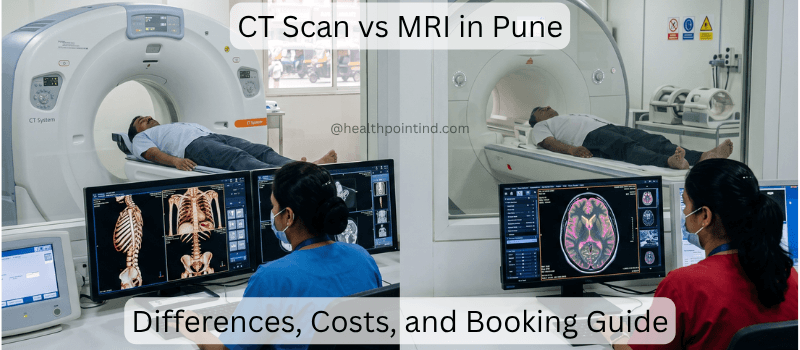
CT Scan vs MRI in Pune: Which One Has Your Doctor Prescribed and Why It Matters
Written by the Health Point IND Editorial Team | Fact-Checked by the Health Point IND Expert Team on June 27, 2026
If you have been handed a prescription for either a CT scan or an MRI in Pune, your first instinct might be to assume the two investigations are essentially interchangeable, with the choice driven simply by cost or lab availability.
They are not interchangeable. The specific choice your doctor has made carries vital clinical meaning. The two technologies see the human body in fundamentally different ways, answer different diagnostic questions, and carry different practical implications for you while sitting inside the scanner.
Understanding why your doctor chose a specific scan helps you book the right investigation at the right facility without the confusion that often costs patients across Pune time, money, and accuracy.
The Core Difference: How They See Inside Your Body
What is a CT Scan?
CT (Computed Tomography) uses advanced X-ray beams that rotate rapidly around your body while you lie on a moving table. Detectors measure how much radiation passes through different tissues, and a powerful computer reconstructs detailed cross-sectional images of your anatomy in three dimensions.
-
Best Used For: CT excels at imaging bone, calcified structures, and tissues with significant density differences. Lung parenchyma, kidney stones, fresh internal bleeding, complex fractures, and the acute structure of organs all appear with remarkable clarity.
-
The Emergency Standard: This is why it remains the first-line investigation in emergency departments across Pune for acute trauma, suspected strokes, sudden abdominal pain, or blood clots.
-
The Consideration: CT imaging utilizes ionizing radiation, though modern low-dose CT systems have reduced this exposure substantially.
What is an MRI Scan?
MRI (Magnetic Resonance Imaging) uses absolutely zero radiation. Instead, it employs a powerful magnetic field to temporarily align hydrogen protons within your body. Radiofrequency pulses disturb that alignment, and the signal those protons emit as they return to their natural state is converted into highly detailed images.
-
Best Used For: The result is exceptional soft tissue contrast. Brain tissue, the spinal cord, nerves, ligaments, tendons, cartilage, and muscle all appear in depth that a CT scan cannot match.
-
The Consideration: An MRI takes significantly longer than a CT scan, requires you to lie completely still inside a narrow bore, and has strict safety clearance protocols for patients with metallic implants.
Quick Comparison: CT Scan vs. MRI
| Feature | CT Scan | MRI Scan |
|---|---|---|
| Radiation Used | Yes (Low-Dose Ionizing X-Rays) | None (Magnetic Fields & Radio Waves) |
| Average Scan Time | 3 to 15 minutes | 20 to 75 minutes |
| Best For | Bones, kidney stones, acute bleeding, chest/lungs | Brain, spinal cord, ligaments, tendons, soft tissues |
| Claustrophobia Risk | Very Low (Wide, short open ring) | Moderate (Longer, enclosed scanning tube) |
| Pricing Setup | More accessible baseline cost | Higher baseline operational cost |
When Your Doctor Prescribes CT vs. MRI
The choice between these two modalities is never arbitrary. It is a strict clinical decision driven entirely by what your physician needs to see to make an accurate diagnosis.
When CT is the Mandatory Choice:
CT is the ideal choice for acute health presentations where speed is critical, and the primary question involves bone anomalies, fresh internal bleeding, or air spaces:
-
A patient presenting to an emergency department in Hadapsar or Kharadi with a severe, sudden headache receives a CT brain first to instantly rule out a hemorrhage.
-
Sudden, acute abdominal pain is evaluated via a CT abdomen to look for appendicitis, kidney stones, or bowel obstructions.
-
Cancer staging protocols frequently begin with a contrast-enhanced CT because it can survey the chest, abdomen, and pelvis within a few minutes.
When MRI is the Mandatory Choice:
MRI is requested when the clinical focus is on soft tissue integrity, when no immediate emergency dictates rapid speed, and when avoiding radiation is preferred:
-
Neurological conditions like multiple sclerosis, complex brain tumours, spinal cord compression, and deep stroke evaluations are absolute MRI territory.
-
Sports medicine and orthopaedics rely heavily on MRI to safely evaluate torn ACLs, meniscus tears, or rotator cuff injuries.
-
Pelvic evaluations for conditions like endometriosis or gynaecological cancer staging require the precise soft tissue mapping that only an MRI can provide.
CT Scan vs. MRI Cost in Pune: What You Actually Pay
A CT scan cost in Pune at standard private diagnostic centres typically runs lower than an MRI for equivalent body regions. This reflects the shorter machine runtime, lower equipment maintenance, and faster patient turnover.
An MRI is fundamentally more expensive because the equipment is highly capital-intensive, the specialized magnet requires continuous liquid helium cooling, and the radiologist's reporting time per case is far greater.
Through the pre-negotiated network partnerships built by Health Point IND across 27+ accredited labs in Pune and PCMC, patients can access specialized diagnostic imaging at exclusive rates up to 60% lower than typical walk-in private prices:
-
Pune CT Scan Rates: Price starts from ₹1,999, depending entirely on the body part and contrast requirements.
-
Pune MRI Scan Rates: Price starts from ₹2,799, depending on the target region and specific sequence protocols.
Note: Exclusive network savings may vary slightly based on your chosen lab location and specific machine configuration. Booking the incorrect scan format just to save money can lead to inconclusive results, forcing you to repeat the process. Always match your booking exactly to your physical prescription.
Practical Differences Inside the Scanner Room
The CT Experience
The scan is incredibly fast and completely painless. You lie on a flat table that slides smoothly through a short, doughnut-shaped ring. Because the scanner ring is wide and shallow, feelings of claustrophobia are extremely rare. If intravenous contrast dye is required to highlight blood vessels, you will experience a transient, harmless sensation of warmth spreading through your body.
The MRI Experience
The process requires patience. You lie inside a deep, metallic tube structure. The machine produces loud, rhythmic knocking and tapping sounds throughout the sequences as the internal gradient coils activate. This is entirely normal, and the technologist will provide specialized headphones or earplugs for your comfort. If contrast dye is required for an MRI, it uses a gadolinium-based compound that does not cause a warm flush sensation.
Absolute Safety Rule: Because the MRI magnet is always turned on, you must strictly declare all internal metallic implants before entering the room. Pacemakers, cochlear implants, certain brain aneurysm clips, or metallic fragments in the eye can be highly dangerous if they are not explicitly certified as "MRI Conditional."
How to Secure the Exact Scan Your Doctor Wants
To ensure a seamless booking process, always read your physical prescription note carefully. Check if your doctor has specified a highly targeted protocol variant rather than a generic review. Specialized tracks like an MRI Brain MS Protocol, a CT Triphasic Abdomen, or an MRI Defecogram require distinct software setups and subspecialty radiologist expertise.
When you connect with the patient support team at Health Point IND, simply send a clear photograph of your prescription over WhatsApp.
Our team will instantly decipher your doctor's exact clinical instructions, match you with the nearest NABL-accredited partner lab housing the correct technical setup, and lock in your exclusive discounted rate across major Pune zones including Baner, Kothrud, Wakad, Hinjewadi, Hadapsar, Kharadi, Shivajinagar, and Pimpri-Chinchwad.
Frequently Asked Questions
What is the single biggest difference between a CT and an MRI in Pune?
A CT scan relies on low-dose X-ray radiation to take rapid, high-density pictures of bones and acute internal bleeding. An MRI relies on powerful magnetic fields with zero radiation to map soft tissues, nerves, ligaments, and deep organ architecture. They are separate diagnostic tools designed for entirely different medical issues.
Is an MRI universally better than a CT scan?
No, neither tool is universally superior. A CT scan is vastly superior for emergency trauma, lung evaluations, and detecting calcium-heavy kidney stones. An MRI is the gold standard for ligament tears, spinal disc issues, and detailed brain neurology. The right choice is simply what your doctor needs to see.
Why does an MRI cost more than a CT scan across Pune labs?
MRI setups require massive electricity draws, continuous liquid helium cooling, long scanning slots per patient (up to an hour), and highly specialized radiologist interpretation times, which naturally drives up the baseline operational costs compared to a quick CT scan.
Can I request a CT instead of an MRI to save on my medical bill?
No, this is highly unsafe. If a surgeon needs to check a torn knee ligament, a CT scan will show virtually nothing, meaning you will waste money on an incorrect test and still have to pay for the correct MRI later. If you are worried about costs, share your prescription with Health Point IND to locate our lowest network pricing for that exact test.
How do I safely book my prescribed scan through Health Point IND?
The process is built to save you time. Simply save our helpline number +91 77964 00040 and send a quick image of your prescription via WhatsApp. Our local team will evaluate the notes, find the closest NABL-accredited diagnostic center with the correct equipment, and book your appointment with your network discount.
Conclusion
CT and MRI scans serve entirely distinct, essential roles in modern medicine. The perfect scan for your health journey is simply the exact one your doctor has chosen to answer your clinical questions.
Health Point IND bridges the gap across Pune and PCMC, ensuring you can access premier, accredited diagnostic infrastructure and elite subspecialty reporting without facing standard walk-in costs. Share your prescription with our support team, select your preferred local hub, and we will handle all your diagnostic logistics smoothly.
Disclaimer: This article is provided purely for informational and educational purposes. It does not serve as a substitute for professional medical advice, real-time diagnosis, or personalized treatment plans. Always consult with a qualified healthcare professional before scheduling any advanced radiological procedures. For immediate test bookings in Pune, contact Health Point IND at +91 77964 00040 or visit https://www.healthpointind.com