
Fatty Liver Grade 1, 2, 3: Reading Your Ultrasound
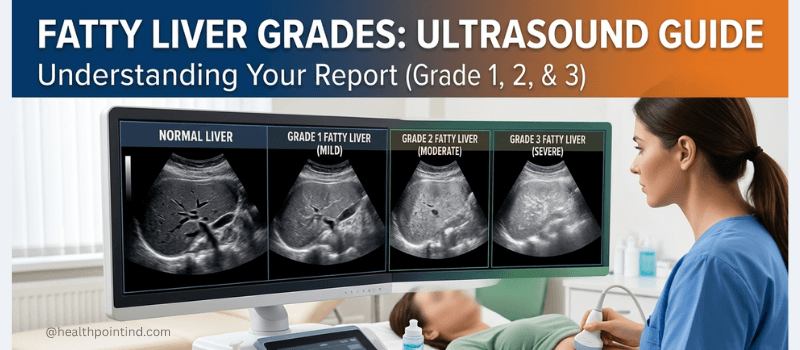
Fatty Liver Grade 1, 2 and 3: What Your Ultrasound Report Actually Means
Fatty liver turns up on ultrasound reports constantly, and it is very often an incidental finding. Someone goes in for an abdominal scan because of vague stomach discomfort, or as part of a routine health check, and the report comes back mentioning grade 1 or grade 2 fatty liver alongside whatever they were actually investigating. The word liver in a medical report is alarming enough that most people immediately assume the worst, while others see the word mild and dismiss it entirely. Neither reaction is quite right, and understanding what the grading actually describes helps you land somewhere more useful than either panic or indifference.
What the Radiologist Is Actually Measuring
Fatty liver, medically called hepatic steatosis, means fat has accumulated inside liver cells. On ultrasound, this changes how the liver reflects sound waves. Fat is more echogenic than normal liver tissue, meaning it bounces sound back more strongly and appears brighter on the screen.
The way a radiologist grades this is essentially by comparison. A healthy liver appears roughly similar in brightness to the adjacent right kidney. As fat accumulates, the liver becomes progressively brighter than the kidney, and at the same time, deeper structures become harder to see clearly because the fat scatters the sound waves before they reach them. Two specific structures the radiologist looks for are the diaphragm, sitting behind the liver, and the walls of the blood vessels running through it. How clearly these remain visible is a large part of what determines the grade assigned.
Grade 1: Mild Fatty Liver
In grade 1, the liver appears slightly brighter than the kidney, but the diaphragm and the intrahepatic blood vessel walls are still clearly visible. Fat content is estimated at roughly five to a third of liver weight, though ultrasound does not measure this precisely and the grading is a visual assessment rather than a numerical one.
Practically, grade 1 rarely causes symptoms, which is exactly why the overwhelming majority of cases are discovered incidentally during a scan done for an entirely different reason. This is also the stage at which the situation is most readily reversible. The liver has genuine regenerative capacity, and grade 1 steatosis frequently resolves substantially with sustained weight reduction, dietary change, reduced or eliminated alcohol, and regular physical activity.
The mistake people make at this stage is treating mild as meaning irrelevant. Grade 1 is not a crisis, but it is a genuine signal about metabolic health, and it frequently travels alongside insulin resistance, elevated triglycerides, and early prediabetes, all of which are worth checking rather than ignoring.
Grade 2: Moderate Fatty Liver
In grade 2, the liver is noticeably brighter than the kidney, and the intrahepatic blood vessel walls become harder to distinguish, though the diaphragm usually remains visible. Fat content is higher, and the degree of increased echogenicity is more pronounced.
Grade 2 still frequently produces no symptoms, though some people report a vague fullness or dull discomfort in the upper right abdomen. Clinically, grade 2 is the point at which most physicians move from general lifestyle advice to a more structured assessment, because the likelihood of accompanying inflammation, rather than just fat accumulation, rises meaningfully at this stage.
Reversal remains genuinely possible at grade 2, but it typically requires more sustained and deliberate change than grade 1, and usually benefits from medical supervision rather than a self-directed attempt.
Grade 3: Severe Fatty Liver
In grade 3, the liver appears markedly bright, and both the intrahepatic vessel walls and the diaphragm become difficult or impossible to visualise clearly, because the fat is scattering so much of the ultrasound signal. Radiologists frequently describe this as diffuse fatty infiltration.
Grade 3 warrants prompt medical attention rather than a wait-and-watch approach. The concern at this stage is progression to non-alcoholic steatohepatitis, usually abbreviated as NASH, where the accumulated fat triggers active inflammation and the liver begins to develop fibrosis, meaning scar tissue. Fibrosis, unlike fat, is considerably harder to reverse, and sustained fibrosis can progress toward cirrhosis over years.
The Critical Limitation Most Reports Do Not Explain
Here is the part that genuinely matters and that most patients never have explained to them. The grade on your ultrasound tells you how much fat is present. It tells you nothing at all about whether inflammation or scarring has already started.
This distinction is not academic. A person with grade 2 fatty liver who has developed NASH with early fibrosis is in a considerably more serious position than a person with grade 3 fatty liver that is purely steatosis with no inflammation. Ultrasound grading cannot distinguish between them. Two people with identical report wording can have meaningfully different clinical situations.
This is why your doctor will frequently order additional tests alongside the ultrasound rather than treating the grade as the complete picture.
What Tests Usually Follow a Fatty Liver Finding
Liver function tests measure enzymes including ALT and AST. Elevated levels suggest active liver cell injury, which points toward inflammation rather than simple fat accumulation. Normal enzymes do not entirely exclude NASH, but elevated ones are a meaningful signal.
Fasting glucose and HbA1c are checked because fatty liver and insulin resistance are closely linked, and a substantial proportion of people with fatty liver have undiagnosed prediabetes or diabetes.
Lipid profile is checked because elevated triglycerides commonly accompany fatty liver and contribute to the same underlying metabolic picture.
FibroScan, also called transient elastography, is a specialised ultrasound-based test that measures liver stiffness, which correlates with fibrosis. This is the investigation most useful for answering the question ultrasound grading cannot, namely whether scarring has begun.
Viral hepatitis screening is sometimes included to exclude hepatitis B and C as contributing causes, particularly when liver enzymes are elevated.
In selected cases where the picture remains unclear, and the answer would change management, a specialist may recommend liver biopsy, though this is reserved for specific situations rather than routine.
Why Fatty Liver Is So Common in People Who Do Not Drink
A widespread misconception is that fatty liver is an alcohol problem. Non-alcoholic fatty liver disease is now the most common liver condition globally, and in India it is found frequently in people who have never consumed alcohol at all.
The drivers are metabolic rather than alcoholic. Central obesity, meaning fat carried around the abdomen specifically, insulin resistance, type 2 diabetes, elevated triglycerides, and a diet high in refined carbohydrates and sugar all contribute. This matters particularly in the Indian context, where a phenomenon sometimes described as thin-outside-fat-inside is well documented, meaning people with a normal body mass index can still carry significant visceral fat and metabolic risk. A normal weight does not exclude fatty liver.
Sunita, a 41 year old who has never consumed alcohol and whose weight sits within normal range, had an abdominal ultrasound for unrelated intermittent discomfort. The report mentioned grade 2 fatty liver, which she found genuinely confusing given her lifestyle. Her physician ordered liver function tests, HbA1c, and a lipid profile alongside a repeat assessment. Her ALT was mildly elevated, her HbA1c sat in the prediabetic range, and her triglycerides were high. The fatty liver was not an isolated finding at all. It was the visible marker of a metabolic picture that had been developing silently and that she would not otherwise have discovered for years.
Can Fatty Liver Actually Be Reversed
Yes, particularly at grades 1 and 2, and the evidence for this is reasonably strong. The liver's regenerative capacity is genuine. Sustained weight reduction, commonly cited as a target of around seven to ten percent of body weight where overweight, is one of the most consistently effective interventions. Reducing refined carbohydrates and added sugar, increasing physical activity to a routine rather than occasional bursts, eliminating alcohol, and managing coexisting diabetes and lipid abnormalities all contribute.
What does not work is treating fatty liver as a standalone problem to be fixed with a supplement while the underlying metabolic drivers remain unaddressed. Fatty liver is generally a symptom of a broader metabolic state rather than an isolated organ problem, and it responds to changes that address that broader state.
Progression is not inevitable, but neither is spontaneous improvement. What happens next depends substantially on what changes.
Preparing for an Abdominal Ultrasound
Fasting for around eight hours before an abdominal ultrasound is standard, because food and drink cause the gallbladder to contract and increase bowel gas, both of which obscure the view of the liver and surrounding structures. Water is generally permitted in small amounts, and specific instructions vary slightly by lab.
The scan itself is painless, takes around fifteen to twenty minutes, involves no radiation, and requires no recovery time. The report is reviewed by a radiologist before reaching your doctor.
Booking an Abdominal Ultrasound
An abdominal ultrasound is the standard first investigation when fatty liver is suspected or being monitored. Pricing depends on whether a focused liver scan or a complete abdominal study is ordered, and on the lab location. Call or WhatsApp +91 77964 00040 to confirm pricing and availability at an accredited lab near you.
Frequently Asked Questions
What does grade 1 fatty liver mean on my ultrasound report?
Grade 1 means mild fat accumulation in the liver, with the liver appearing slightly brighter than the adjacent kidney while the diaphragm and blood vessel walls remain clearly visible. It rarely causes symptoms and is the most readily reversible stage, typically responding well to weight reduction, dietary change, and regular physical activity.
Is grade 2 fatty liver serious?
Grade 2 indicates moderate fat accumulation and is generally the stage at which doctors move from general advice to structured assessment, because the likelihood of accompanying inflammation rises. It remains reversible with sustained change, but usually benefits from medical supervision and additional testing to check whether inflammation has begun.
Can fatty liver be reversed completely?
At grades 1 and 2, substantial and sometimes complete reversal is genuinely achievable through sustained weight reduction, reduced refined carbohydrates and sugar, regular exercise, eliminating alcohol, and managing any coexisting diabetes or lipid abnormalities. Reversal becomes more difficult once fibrosis has developed, which is why identifying the situation early matters.
Does the ultrasound grade tell me if I have liver damage?
No, and this is the most important limitation to understand. The grade describes how much fat is present but cannot distinguish between simple fat accumulation and NASH, where inflammation and scarring have begun. Liver function tests and, where indicated, a FibroScan are used to assess that separately.
Can I have fatty liver without drinking alcohol?
Yes. Non-alcoholic fatty liver disease is now the most common liver condition globally and is driven by metabolic factors including central obesity, insulin resistance, diabetes, elevated triglycerides, and diets high in refined carbohydrates. Many people diagnosed with fatty liver have never consumed alcohol.
Can I have fatty liver at a normal weight?
Yes. People with a normal body mass index can still carry significant visceral fat and insulin resistance, a pattern well documented in Indian populations. Normal weight does not exclude fatty liver, which is part of why it is so frequently found incidentally in people who assumed they were not at risk.
What tests should follow a fatty liver diagnosis?
Liver function tests to check for inflammation, fasting glucose and HbA1c given the strong link with insulin resistance, and a lipid profile are commonly ordered. Where fibrosis assessment is needed, a FibroScan measures liver stiffness. Your doctor decides which of these apply based on your grade, symptoms, and overall risk profile.
Fatty liver on an ultrasound report is neither something to panic about nor something to file away and forget. It is a signal worth following up properly, because what it points toward is frequently more informative than the finding itself.
Important: This article is for informational and educational purposes only. It is not a substitute for professional medical advice, diagnosis, or treatment. Always consult your doctor or a qualified healthcare professional before undergoing any diagnostic test. For diagnostic test bookings in Pune, contact Health Point IND at +91 77964 00040 or visit https://www.healthpointind.com